Some decisions just can't be taken by umpires on the field during a cricket match. That's where a third umpire comes in. He is the overlord. After taking his time, with the press of a button, he can break a million hearts or give resounding hope. We all know how things go down on the field and on television.
Fans hold their breath, cross their fingers and after what seems like an eternity, the light goes on. Depending on the colour, we curse or praise the 3rd umpire.
Well, the technology was introduced in November, 1992 for a Test match between India & South Africa.
Interestingly, Sachin Tendulkar was the first batsman to be given out using television replay (I'm sure we hated that moment). And back then, green meant out!
But obviously, the technology wasn't as 'advanced' back in the day.
Slowly, it evolved, and from just deciding run outs, the third umpire had to also decide if the ball had cleared the ropes when a fielder dove in to save a boundary. Or whether the ball cleared for a six or stayed in the field.
BlackBerry users, here is the news that you don't want to hear !
Facebook-owned WhatsApp and is dropping support for BBOS and BlackBerry 10 devices at the end of the year, now Facebook itself will discontinue supporting the platform. That means the Facebook and Messenger apps will no longer work on either platform.
The announcement was made on the Inside BlackBerry blog last week.
BBOS runs on older BlackBerry devices, such as the Bold. BlackBerry 10 powers more recent devices such as the Passport and Classic.
BlackBerry 10 operating system in favor of Android-powered devices, such as the BlackBerry Priv ,will continue to be able to run the Android version of facebook's apps.
On the othert side, BlackBerry 10 users can still download and install the Android version of the Facebook app through the Amazon App Store, or use the mobile Facebook site to access their accounts. BlackBerry 10 has long included the ability to run Android apps, but it’s not the best experience. Often features don’t work, or apps fail to open at all.
The most powerful 4‑inch phone ever with a known design, then reinvented it from the inside out. The A9 is the same advanced chip used in iPhone 6s. The 12‑megapixel camera captures incredible photos and 4K videos. And Live Photos bring your images to life. The result is an iPhone that looks small. But lives large.
In short iPhone SE, which is essentially an iPhone 6s stuffed into a 5s case. It has everything you’d expect from the latest iPhone: The A9 processor is three times faster than the chip in the 5s. There’s a 12-megapixel camera that also captures 4K video. It has Touch ID. You can get it in rose gold and it starts at $399. The only exception is 3D Touch functionality.
The tech is new, but the design is so four years ago. Look past the matte edges and the SE logo and this phone is a dead ringer for the iPhone 5s. This is perhaps one of Apple’s most telling design admissions to date. The fact is, the iPhone 5 (and 5s) has long been the golden child of Apple phone design and a benchmark for phones in general.
In fact, the iPhone SE is the cheapest launch price for an Apple smartphone at $399. The story, for a while, got even better for the Indian customer as Apple initially announced that the 16GB version of this phone would be priced in India at a very aggressive Rs 30,000. However, the price was later corrected to a more Apple-like Rs 39,000.
Android is the largest and the most used OS available now. Android 6.0 Marshmallow launched in early October 2015, over five months ago, and yet it’s only installed on a mere 2.3% of Android devices that access the Google Play Store.
According to the android statistics, The version with the largest installed base is the previous one, Lollipop, at 36.1%.To compare, this is a 1.1 percent increase from the February figure of 1.2 percent. Back in January and December, the Android Marshmallow figures stood at 0.7 and 0.5 percent respectively.
It is said that this is the first time that Android Lollipop running devices have gone past Android KitKat-powered devices. The devices running KitKat are going down steadily in charts and the version now powers 34.3 percent devices compared to 35.5 percent last month - a decrease of 1.2 percent.
Android Jelly Bean is still holding strong at 22.3 percent, a decrease of 1.6 percent from last month. Ice Cream Sandwich, Gingerbread and Froyo are still all holding on with dear life with 2.3, 2.6 and .1 percent, respectively. Google says that any versions of Android with less than .1 percent distribution aren’t shown on the chart.
Quantum dots are nothing but a simple programmable matter. Don't think about it as in case of a sci-fi movie, but it actually closely resembles it.
Moving into the theory these are kind of semi-conductors which we use in the daily life but here the electrons and the holes are confined in the three spacial dimensions and of course very tightly packed. They exhibit electrical properties which one can actually use it for different purposes as like in the LED, solar cells, transistors and diode cells.
The term "Quantum Dots" was first coined by Mark Reed. When I described it as a programmable matter it actually doesn't define it on a large scale but it can be controlled by various methods. Just in case, if you need to control the photo luminescence of these dots, you can do it by varying the diameter of the dots. The larger diameter dots emit out frequencies of greater wavelength and vice versa.
For a detailed explanation we are intended to embed a video which can take you through a brief description over what is quantum dots.
Video credits : Cnet
In recent days, Samsung and LG are in the race of manufacturing televisions using this technology but the sad part is that Samsung couldn't take much of the share in promoting it.
Coming to the disadvantages, these televisions are priced much higher than the normal UHD televisions which makes them unreachable from the normal mediocre market.
Let's hope for the better generation televisions from all the manufacturers at a lower price tag.
Anyways quantum dots will help the future as well as the present generation in revolutionizing the display technology.
Boston dynamics, the most renowned robotics company owned by Google is now all set to work out with its prototype ATLAS, the humanoid. It actually takes the work as like the humans. This robot is well managed to survive in the extreme conditions. It is equipped to walk in snow, pick things that are much heavier and so on. We have found some interesting things about the Atlas which was shared by the founder of the Boston Dynamics, Mr. Marc Raibert with IEEE Spectrum and this is a quick overview about it,
At 5’9” (1.75 m) and 180 lbs (82 kg), the new ATLAS is much shorter and lighter than the previous model, which was 6’2” (1.9 m) and 345 lbs (156 kg). See family photo above for comparison.
It looks like BD decided that electric motors aren’t yet up to the task of getting a 180-pound robot to walk around, so they stuck with the more complicated (and generally messier) hydraulic system. Other legged robots do this too, and it seems like a reasonable compromise between the quiet efficiency of electricity and the power of hydraulics.
That dynamic balancing reminds us a lot of the early BigDog videos, but it’s crazy to see it running in a biped like this, because of the speed at which the limbs have to move while still supporting the upper body.
We’re not exactly sure how much autonomy it’s got going at this point. While walking outdoors, the LIDAR appears not to be spinning much of the time, which means someone is likely driving the robot. Some of the box lifting looks to be autonomous, but we’re definitely looking for some background on what’s going on behind the scenes when the robot is stacking boxes on those shelves.
It can fall over, and not only not die, but get up again by itself. There were a few layers of mats underneath the robot, and one video doesn’t reveal a whole lot about its overall robustness, but this is miles better than any other humanoid robot short of CHIMP (if you want to call CHIMP a humanoid).
We hope that this project will lead us to the next generation of the andro-humanoid robots which can make us to set some new parameters in robotics.
We are putting up a small video of the upgraded version of the Atlas, doing some of the chores.
Credits Reference: IEEE Spectrum, Inverse. Images: Google Video: Youtube
Facebook says that “Free Basics is a
first step to connecting 1 billion Indians to the opportunities online – and
achieving digital equality in India.
Free Basics, which
allows people to browse selected health, jobs, social and local portals without
data charges, has met with significant resistance in India. While Facebook,
which will be among the free offerings, argues that Free Basics will help to
expand significantly the access and reach of the internet, benefiting the poor
in particular.
Facts about free
Basics:
Facebook doesn’t pay for Free Basics,
telecom operators do. Where do they make money from? From users who pay.
By encouraging people to choose Free Basics, Facebook reduces the propensity
to bring down data costs for paid Internet access.
Free Basics isn’t about
bringing people online. It’s about keeping Facebook and its partners free,
while everything else remains paid. Users who pay for Internet access can
still access Free Basics for free, giving Facebook and its partners an
advantage. Free Basics is a violation of Net Neutrality
Free Basics is not an open platform. Facebook defines the
technical guidelines for Free Basics, and reserves the right to change
them. They reserve the right to reject applicants, who are forced to
comply with Facebook’s terms. In contrast they support ‘permissionless
innovation’ in the US.
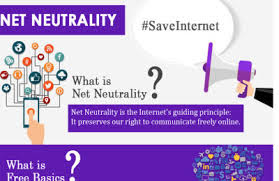
Net neutrality?
The principle that Internet service providers should enable access to all content and applications regardless of the source, and without favouring or blocking particular products or websites.
Opponents say it will
raise the cost of access for those not part of the free package, and
discriminate against those seeking to compete with the free offerings -a
violation of the widely-accepted principle of keeping the net neutral.
In simple words: probably,we may
need to pay to visit a website even once! In future.
Paytm's Sharma slammed Free Basics on Twitter:
"Oh my fellow Indians, either choose this (Free Basics) & do a jihaad
for independent internet later or pick #NetNeutrality today ."
People in India think that the word
"FREE" means everything free,It says that only some part of them are
free and to view the other websites,we need to pay.
So,wake up! support the side you want to be.
Do you want to accept "FREE" or Do you
want to be "FREE"?
Basically leeches belong to the phylum annelida and comprise the subclass hirudinea. This particular subclass is because of a reason which we are going to see further in the post. These leeches prefer to live in moist places so most of them can be found in fresh water environments. Talking about their physical body, they do not have bristles like earthworms though both belong to the same phylum. Instead, they have two suckers, one at each end which help them to suck blood.
It is generally believed that leeches only feed on sucking blood, but it is not so. They also feed on other small invertebrates by swallowing them as a whole. Some leeches feed off decomposing bodies as they can not bite.
Leeches attach themselves to the host and release a combination of mucus and suction to remain attached. After this they release an anti-coagulant enzyme, called hirudine into the host's blood, which is probably why they belong to the subclass hirudinea. These leeches release an anesthetic into the body which is why we don't feel pain. But this presence of anesthetic haven't been proved yet, though scientists found some morphine like substance in them. This hirudine restricts the blood to clot thus allowing it to flow continuously till the host's body is able to clot it. Once they are done with sucking the blood, they just simply fall off the body to digest the blood they've sucked.
There are different views of how to remove a leech. Some say that it can be removed by introducing some kind of fire, or pouring chemicals like alcohol but in that case the leech may vomit the blood it has already sucked into the body again which may result in infections. So picking it with hand is advised by some other people. But frankly speaking, a leech sucking blood wouldn't really effect your blood level. And once it is done, it will anyway drop off.
Besides this, they are also used for medicinal treatments. In simple words, when a situation arises where the body fluids like blood, bile, phlegm are not in control, these leeches are used to balance them. They have applications in the plastic and reconstructive surgeries in good olden days. Hirudin is under research to be used as coagulant. Interestingly, a leech used for one person is never used to another to ensure that any virus doesn't transfer from the former.
A new version of iOS -- 9.2 -- is now rolling out for Apple’s iPhone, iPad and iPod Touch. Installing it will bring some nice new enhancements to your Apple devices, so grab it as soon as you can.
Highlights include improvements to Apple Music, which now shows you exactly which songs have been downloaded to your device, and the ability to directly connect a digital camera to your iPhone’s lightning connector to transfer pictures.
Apple also released watchOS 2.1, its operating system for the Apple Watch, OS X 10.11.2 for the Mac, and tvOS 9.1 for the Apple TV.
Here’s the full details on Updated iOS.
Apple Music improvements.
You can now create a new playlist when adding a song to a playlist.
Your most recently changed playlist is now listed at the top when adding songs to playlists.
Download albums or playlists from your iCloud Music Library by tapping the iCloud download button.
See which songs have been downloaded with the new download indicator next to each song in My Music and Playlists.
See works, composers, and performers while browsing Classical music in the Apple Music catalog.
A new Top Stories section in News so you can stay up to date with the most important news of the day (available in the United States, United Kingdom, and Australia).
Mail Drop in Mail for sending large attachments.
iBooks now supports 3D Touch to peek and pop pages from the table of contents, your notes and bookmarks, or from search results inside a book.
iBooks now supports listening to an audiobook while you browse your library, read other books, or explore the iBooks Store.
iPhone support for the USB Camera Adapter to import photos and videos.
Improved stability of Safari.
Improved stability of Podcasts.
Fixing an issue that caused mail attachments to be inaccessible for some users with POP email accounts.
Resolving an issue for some users that caused attachments to overlap text in mail.
Fixing an issue where Live Photos could have turned off after restoring from a previous iCloud backup.
Addressing an issue that could cause search in Contacts to display no results
Resolving an issue that could have prevented Calendar from displaying all seven days in week view.
Fixing an issue where Camera screen on iPad could be black when attempting to capture video.
Addressing an issue that could cause instability in the Activity app when viewing the day of Daylight Savings Time transition.
Fixing an issue that could prevent data from appearing in Health.
Fixing an issue that could prevent Wallet updates and Lock screen alerts from displaying.
Addressing an issue where updating iOS could prevent an alarm from going off.
Fixing an issue where some users were unable to login to Find my iPhone.
Fixing an issue that prevented some manual iCloud Backups from completing.
Addressing an issue where using the iPad keyboard could unintentionally trigger text selection mode.
Improved keyboard responsiveness when using Quick Reply.
Improved punctuation input on the 10-key Chinese (Pinyin & Stroke) keyboards with new expanded view of punctuation symbols and better predictions.
Fixing an issue on Cyrillic keyboards where caps lock would be enabled when typing in URL or email fields.
Accessibility improvements.
Fixing issues with VoiceOver when using Camera face detection.
Adding support for VoiceOver to wake up the screen.
Adding support for VoiceOver to invoke app switcher with 3D Touch gesture.
Fixing an issue with Guided Access when trying to end phone calls.
Improved functionality for Switch Control users when using 3D Touch.
Fixing an issue with speech rate of Speak Screen.
Siri support for Arabic (Saudi Arabia, United Arab Emirates).
Don’t worry, as you won’t be missing much. As
astronomers say that the universe will be dark, empty and boring soon.
FINDINGS: The new galaxy and mass assembly
(GAMA)study analysed straight from more than 220,000 distant galaxies and found
that universe has lost about half of its twinkle so far.
HOW WILL IT HAPPEN?
This new finding comes from looking at more
than 200,000 galaxies. The energy they are producing today is about half of
what it was 2 billion years ago. The universe is FADING.
HOW WAS THE STUDY CONDUCTED?
Scientists measured light coming from galaxies
as near as 500 million light years and as distant several billion light years
away. The researches then analysed the light at different wavelengths,ranging
from ultraviolet through visible and infrared. By analyzing straight through
many wavelengths,they could calculate the rate of dimming accurately.
Just as you thought 4G or 5G LTE would finish off Wi-Fi once and for all, Li-Fi appears on the scene to rock its status.Wi-Fi has been great but it's already being outdone in 5G tests and now on a more local scale Li-Fi is 100 times faster, and more secure.
Li-Fi uses light to transmit data rather than Wi-Fi's radiowaves. Although this was still in the testing phases not long ago it's already set to reach the public.
How is it 100 times faster than Wi-Fi?
By using visible light to transmit data Li-Fi is able to increase bandwidth by 100 times. This equates to downloading 18 movies at 1.5GB each, in a single second.
Lab tests revealed that the Li-Fi connection could transmit up to 224 gigbits per second. Now in real world use scientists have reportedly managed to hit a whopping 1GB per second of data transmission.This was first discovered in 2011 at the University of Edinburgh by Harold Haas. He showed that flickering the light from an LED could transmit more data than a cellular tower.
The current iteration uses Visible Light Communication (VLC) which is light between 400 and 800 terahertz. It's a bit like switching a light on and off for Morse code, or more accurately, to send the ones and zeros of binary bits.One of the big advantages of li-fi is the fact that, unlike wi-fi, it does not interfere with other radio signals, so could be utilised on aircraft and in other places where interference is an issue.
While the spectrum for radio waves is in short supply, the visible light spectrum is 10,000 times larger, meaning it is unlikely to run out any time soon.
But the technology also has its drawbacks - most notably the fact that it cannot be deployed outdoors in direct sunlight, because that would interfere with its signal.
Neither can the technology travel through walls so initial use is likely to be limited to places where it can be used to supplement wi-fi networks, such as in congested urban areas or places where wi-fi is not safe, such as hospitals.
The original Raspberry Pi Model B and its successors put a programable computer within reach of anyone with $20-35 to spend.since 2012,millions of people have used a Raspberry Pi to get their first exprience of programming,but still many people remain for whome this cost remains a barrier to entry.So,they have come up with an even cheaper Raspberry Pi to help these people take the Plunge.
The geniuses behind the Raspberry Pi have decided Model B, at $20, was too expensive. They've just released the new Raspberry Pi Zero, priced at $5.
The idea behind Raspberry Pi is to offer the power of computing to everyone, by selling for cheap. This should then free up anyone to be able to code, design and build anything they set their minds to. Examples that have cropped up include smarthome devices, drones and gaming machines.
The new Raspberry Pi Zero might be affordable but it's still packing enough power to run plenty of tasks. For that $5 price you get a 1GHz ARM11 Broadcom BCM2835 processor that's 40 per cent faster than the Raspberry Pi 1 and is backed by 512MB of LPDDR2 SDRAM.
There are a selection of ports on the Zero to help connect it including a microSD card slot, mini-HDMI socket for 1080p video plus an unpopulated 40-pin GPIO header and composite video header. All that and the unit itself is just 65 x 30 x 5mm in size.
The Raspberry Pi Zero runs the Raspbian OS and supports apps like Minecraft and Sonic Pi. It's available to buy now for $5 with nothing or $10 with 8GB storage.